The Rise of AI Agent Development Kits (ADKs): Building Smarter AI Systems Through Integrations
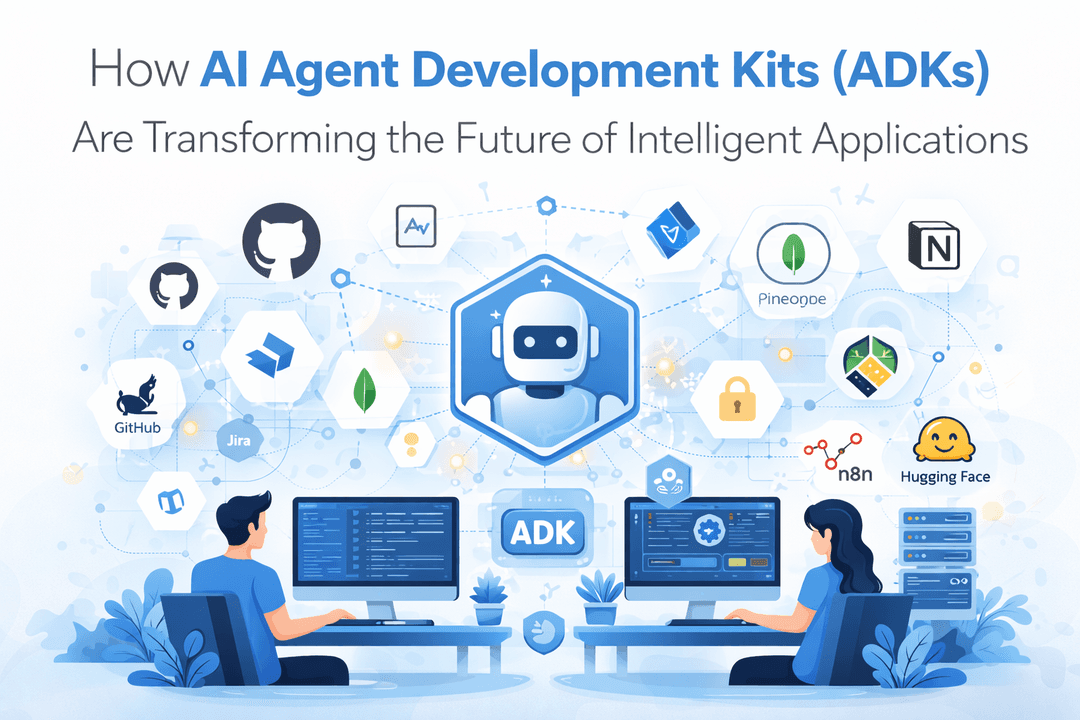
Artificial intelligence is rapidly evolving from simple chat interfaces to autonomous AI agents capable of performing real-world tasks. Instead of just generating responses, modern AI agents can analyze data, interact with tools, execute workflows, and automate complex processes.
A major step toward this future is the ADK Integrations Ecosystem, which expands the capabilities of the Agent Development Kit. This ecosystem enables AI agents to connect with development tools, project management systems, databases, and external services—transforming them from conversational assistants into powerful automation engines.
In this article, we explore how the ADK integrations ecosystem works, the tools it supports, and how it is shaping the next generation of AI-powered applications.
What Is the Agent Development Kit (ADK)?
The Agent Development Kit is an open-source framework designed to help developers build, test, and deploy autonomous AI agents and multi-agent systems. It provides modular building blocks for creating agents that can reason, use tools, access memory, and interact with external systems.
Key components of ADK include:
- Agents – The main decision-making units that interpret instructions and execute tasks.
- Tools – External capabilities such as APIs, databases, or services that agents can use.
- Memory systems – Store information across sessions for context-aware interactions.
- Runners and execution environments – Infrastructure for running and scaling agents.
- Observability and governance tools – Monitor, evaluate, and control agent behavior.
With these components, developers can build complex AI systems that perform multi-step workflows autonomously.
The Need for an Integration Ecosystem
Early AI agents were powerful at reasoning but limited in their ability to interact with real-world systems. They could analyze information and provide recommendations, but executing tasks often required manual integration with APIs or custom scripts.
The ADK integrations ecosystem addresses this limitation by providing pre-built connectors to popular tools and services, allowing developers to extend agent capabilities with minimal effort.
This means an AI agent can now:
- Access repositories and manage code
- Query databases and perform semantic search
- Automate project workflows
- Trigger external services
- Manage payments or send emails
Instead of building integrations manually, developers can enable them with just a few lines of configuration code.
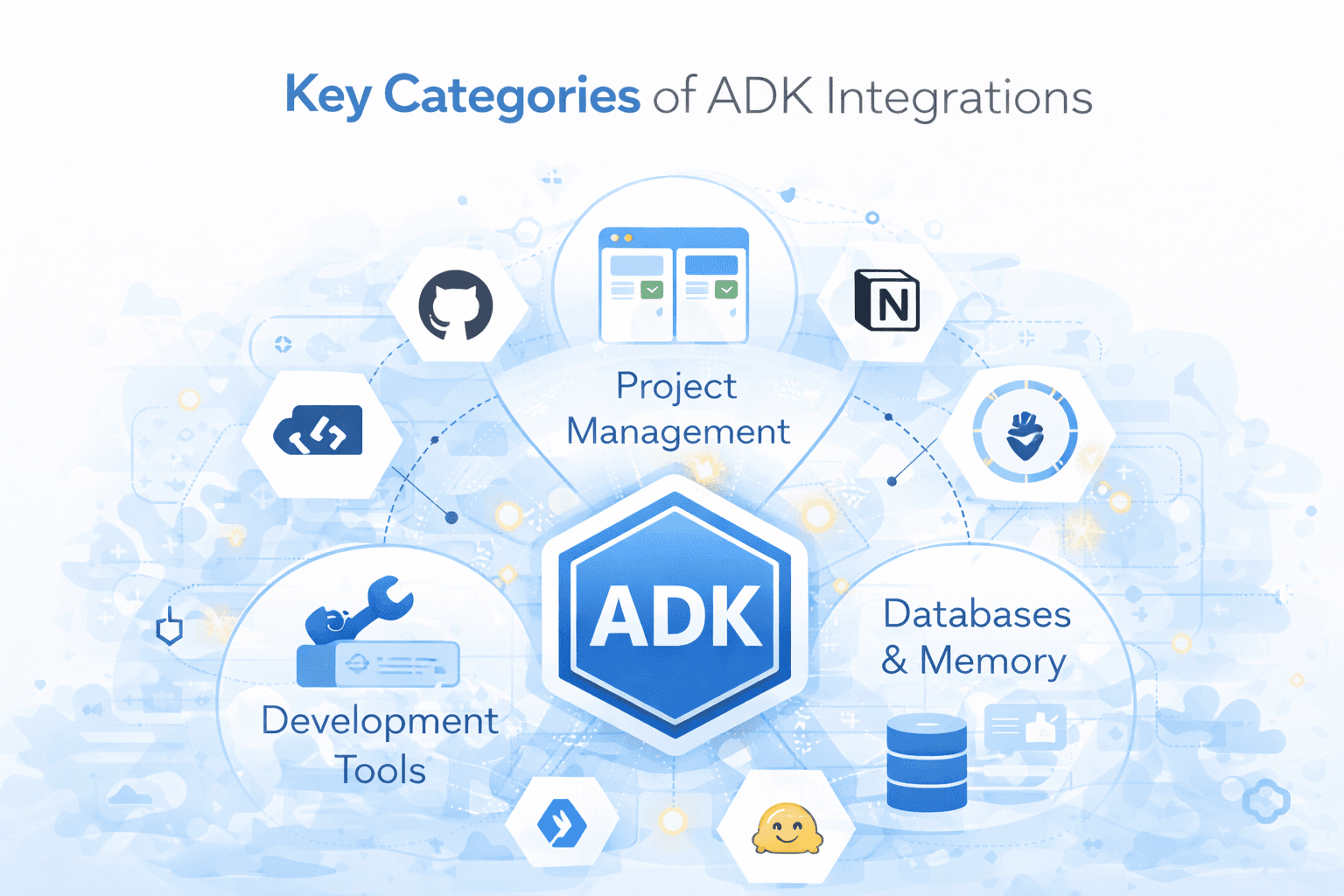
Key Categories of ADK Integrations
The ecosystem includes dozens of integrations grouped into multiple categories, each designed to expand the operational capabilities of AI agents.
1. Development and Code Management Tools
AI agents can now interact directly with developer workflows.
Supported integrations include:
- GitHub
- GitLab
- Postman
- Daytona sandbox execution environment
- Restate for resilient workflows
With these integrations, AI agents can:
- Analyze code repositories
- Create pull requests
- Run commands and scripts
- Test APIs automatically
- Inspect CI/CD pipelines
This transforms AI agents into developer assistants capable of actively managing codebases.
2. Project Management and Collaboration Tools
AI agents can also integrate into team collaboration workflows.
Supported platforms include:
- Asana
- Jira
- Notion
- Linear project tracking
Through these integrations, AI agents can:
- Create and update tasks
- Track project progress
- Generate documentation
- Search knowledge bases
This enables agents to become active participants in team workflows rather than passive assistants.
3. Databases and Vector Search
AI agents often need access to structured and semantic data.
The ADK ecosystem integrates with:
- MongoDB
- Pinecone
- Chroma semantic database
These integrations allow agents to:
- Retrieve structured data
- perform semantic search
- store embeddings
- build retrieval-augmented generation (RAG) systems
As a result, agents can provide more context-aware and data-driven responses.
4. Persistent Memory Systems
To operate effectively over long workflows, AI agents need memory.
The ecosystem includes memory platforms such as:
- GoodMem
- Qdrant
These systems enable agents to store and retrieve knowledge across sessions, enabling long-term contextual awareness.
Persistent memory allows agents to:
- remember past interactions
- learn from previous tasks
- maintain user preferences
5. Observability and Monitoring
Production AI systems require strong monitoring and debugging capabilities.
The ADK ecosystem integrates with observability platforms including:
- AgentOps
- MLflow
- Arize AX
- W&B Weave
- Phoenix
These tools provide:
- session replay
- debugging and tracing
- prompt management
- performance monitoring
This observability layer helps teams analyze and optimize agent performance in production environments.
6. Workflow Automation and External Services
Agents can also connect to integration platforms such as:
- n8n workflow automation
- StackOne SaaS connector
These tools allow agents to integrate with hundreds of external applications and APIs, enabling powerful automation workflows.
For example, an AI agent could:
- monitor incoming support tickets
- create tasks automatically
- notify teams through messaging platforms
- trigger workflows across multiple SaaS tools
7. AI Models and Data Ecosystem
The ecosystem also provides direct access to machine learning resources through integrations like:
- Hugging Face
This allows agents to:
- search models and datasets
- generate AI code
- access research and ML tools
By connecting to the broader AI ecosystem, developers can rapidly prototype and deploy intelligent applications.
Real-World Use Cases of ADK Agents
- The expanded integration ecosystem opens the door to many real-world applications.
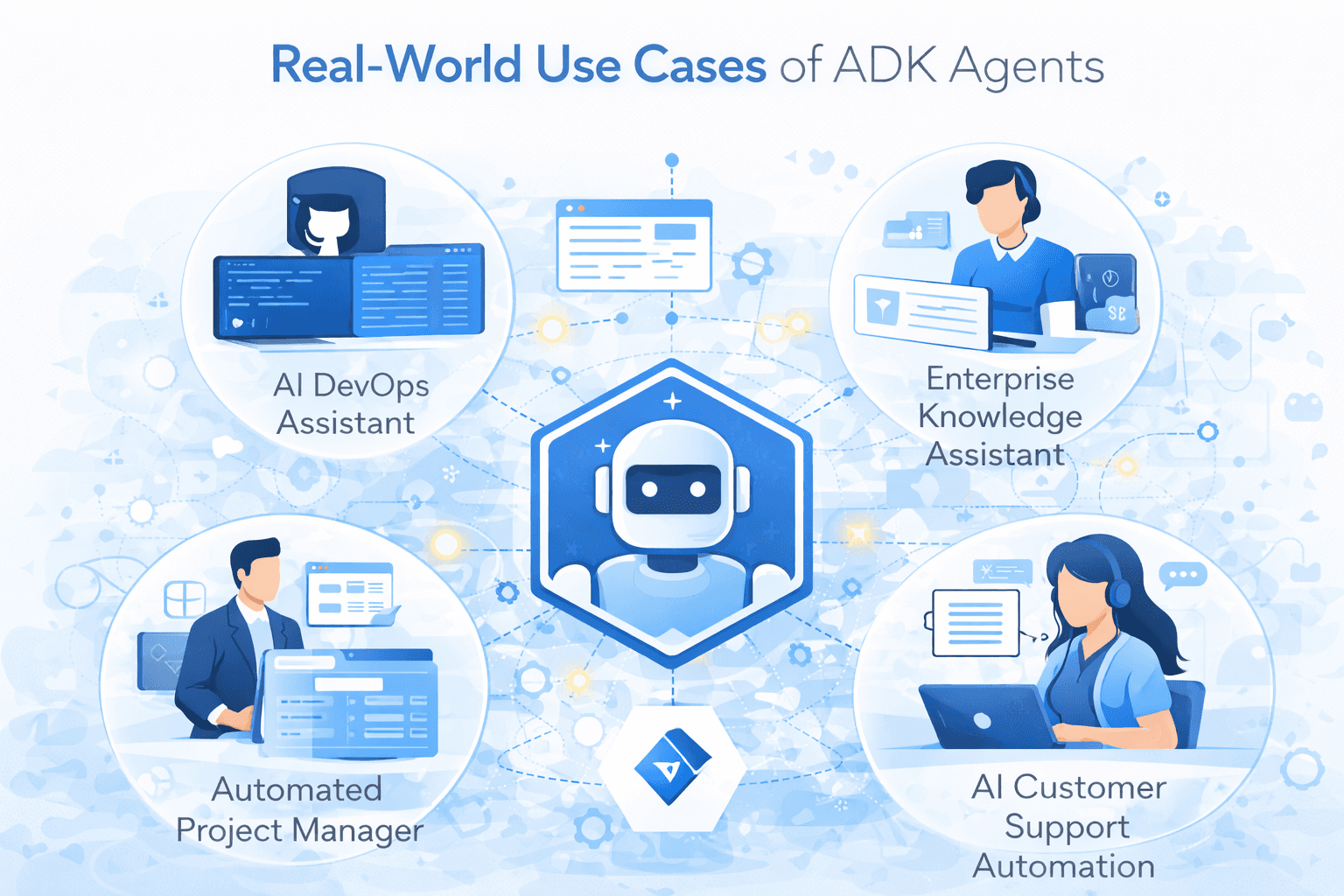
AI DevOps Assistant
- An AI agent monitors repositories, runs tests, and automatically creates pull requests.
Enterprise Knowledge Assistant
- Agents query internal documentation, summarize reports, and answer employee questions.
Automated Project Manager
- Agents track project progress, update tasks, and generate meeting summaries.
AI Customer Support Automation
- Agents retrieve information from databases and resolve customer queries autonomously.
These applications demonstrate how AI agents can evolve from simple chatbots to autonomous digital workers.
Why the ADK Ecosystem Matters
The ADK integrations ecosystem represents a major shift in AI development.
Instead of building isolated AI models, developers can now create connected intelligent systems that interact with real-world software tools and data sources.
This approach accelerates innovation because developers can focus on building intelligent logic rather than spending time integrating APIs.
Industry experts believe this ecosystem could enable a modular “agent economy,” where specialized AI agents interact with tools and services to complete complex workflows.
The Future of AI Agent Development
As the ecosystem grows, AI agents will become increasingly capable of:
- autonomous decision-making
- multi-agent collaboration
- enterprise workflow automation
- cross-platform integration
This will lead to a new generation of applications where AI systems not only provide insights but take action on behalf of users and organizations.
The ADK integrations ecosystem is a foundational step toward this future.
Conclusion
The launch of the ADK integrations ecosystem marks an important milestone in the evolution of AI agents. By connecting AI agents with development tools, business applications, databases, and external services, this ecosystem significantly expands what intelligent systems can accomplish.
Developers can now build AI agents capable of performing real-world tasks, automating workflows, and seamlessly interacting with enterprise platforms at scale.
As more organizations adopt these technologies, AI agents will become a core component of modern software systems—driving the next generation of intelligent automation and digital transformation.
At Cognyx, we help businesses design and build AI-powered solutions using modern technologies and scalable architectures. Explore our AI development services to start building smarter, future-ready digital platforms.
Written by